
Fares Aren’t Fair
Why funding mass transit by charging users is a mistake.

Australia’s perennial PT fare discourse has recently been reignited by the Victorian Greens’ pledge, in the run-up to the Prahran by-election, to push for universal 50-cent fares. The policy is modelled after Queensland’s 50-cent fares, which were brought in by the Stephen Miles ALP government in the run-up to the 2024 state election. That policy was itself plainly inspired by the Queensland Greens 2020 election pledge to bring in $1 fares (a natural position given that entirely free PT is part of the Greens national platform). At that time, the idea was hounded in the press, but it seems to have been a politically shrewd decision on Miles’ part to copy it now; the new 50-cent fares consistently poll as wildly popular–so popular that the David Crisafulli-led LNP ghouls reluctantly matched his promise to keep them if they won the election, which of course the ghouls ultimately did. Nevertheless, I am told by a Queensland Greens polling insider that Miles’ introduction of the fares was the top reason given by Queenslanders who ultimately voted for the ALP after considering voting for the Greens.
Although 50-cent fares are evidently beloved by most Queenslanders and look to be here to stay, the concept of ultra-low fares–or doing away with fares entirely–is fiercely opposed by some. Perhaps surprisingly, this includes some PT advocates who one might’ve thought unlikely figures to be opposing such a policy, let alone so vocally. Numerous prominent 'gunzel' (big-time train enthusiast) accounts on Twitter expressed extreme frustration with the Victorian Greens’ proposal, including outspokenly left-leaning ones. One went so far as to proclaim—earnestly, it would seem—that as a consequence they would no longer be voting for the Greens. Meanwhile, the apparently fare-hawk PTUA spat on the proposal, tweeting that it was a 'distraction' from improving services.
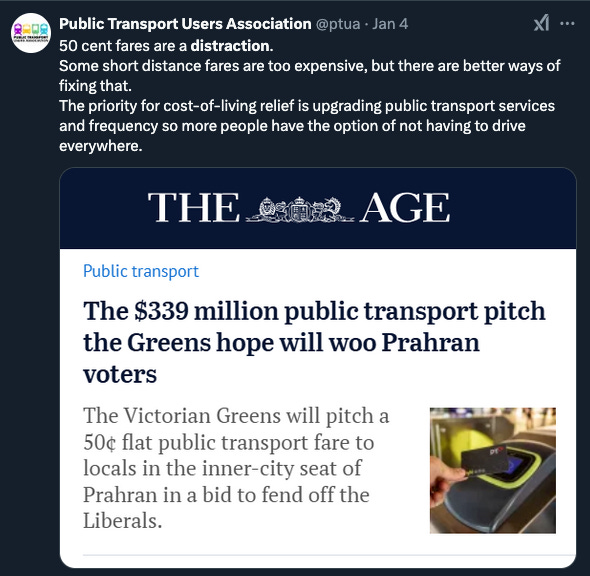
The opposition (and frustration) seems to stem from the idea that fares are necessary to adequately fund public transit, that losing fare revenue will thus make the system worse, and that advocates of abolishing fares are ignoring this out of ideological convenience. This is mistaken on all counts, and I intend to clearly explain why. However, I believe (or at the very least hope) that people on all sides of this discussion broadly share the same goal of a world where excellent public transit is available to all. Therefore, I wish to extend an olive branch to those described above and engage in a spirit of camaraderie rather than the immature toxicity that this Discourse has frequently devolved into. With that said, I’m not going to understate the case for the sake of carefully avoiding conflict through faux nuance. My goal is to convince people to unite around an uncompromisingly maximalist PT agenda that includes fare abolition, and that goal would not be served by pulling any punches.
Fares are a tax on PT use
Although they may not be administered by the tax office, public transit fares are fundamentally a means of raising government revenue. Therefore, they can (and should) be considered a tax on the usage of public transit; let’s call it PT tax. One can quibble over this terminology, but such a quibble would be just that. In truth, it makes no difference what one calls fares, so long as one accepts that it is proper to compare them to other means of raising government revenue. The purpose of this label is to remind us of that.
It is an essential insight of economics that the benefits of a choice cannot be meaningfully evaluated in absolute terms. Rather, the benefits of a choice must be evaluated relative to the benefits of other choices. In other words, opportunity cost cannot be ignored. By way of illustration, just because an investment is profitable does not make it a good investment if there are other far more profitable ventures I could invest my limited resources in instead. This principle equally applies to choices about how to raise government revenue. Fares/PT tax can therefore only be correctly evaluated relative to other taxes.
To merely point to the revenue loss that would be incurred by abolishing PT tax is to fall prey to this economic fallacy of considering a choice in isolation. We should instead treat the cost of PT as a constant and the means of raising revenue to meet it as our variable. PT tax obviously could not be abolished without raising equivalent revenue with other taxes.
Let us then evaluate PT tax fairly, on three criteria; distributional effect, behavioural incentives, and cost of administration.
Distributional Effect
When it comes to their effect on inequality, not all taxes are created equal. The taxes which contribute most strongly to alleviating inequality, by facilitating the redistribution of wealth from those with more to those with less, are progressive taxes. These are so called not because they are politically progressive (though political progressives do tend to support them), but because the proportion of a person’s wealth subject to the tax tends to progressively increase in correlation with the person’s wealth. The most explicit case of this is income tax, where the percentage people pay increases solely as a function of their taxable income. One step down from this are flat taxes, which charge everyone the same rate. An example of this is the Medicare levy, which is calculated as 2% of each person’s taxable income–you pay the same flat percentage no matter how large your taxable income is. Then, there are regressive taxes, where those with more wealth tend to be taxed a smaller proportion of it than those with less. Poll Taxes, which charge all eligible adults the same amount, are a notorious example of this which were once widespread but have now been abolished all around the world. However, it is actually the case that most taxes are regressive–though varying in their level of regression.
For example, although the Goods and Services Tax (GST) may appear to be a flat tax–given that it is always 10%, no matter how little or much is being bought–it is actually regressive. This is because those with less income must spend a greater proportion of it on purchasing goods and services, whereas those with more have surplus that they can afford to save and invest instead. GST therefore tends to tax a smaller proportion of your income the more income you have. Although it is regressive, it still contributes to the redistribution of wealth–just far less so than progressive taxes. In certain instances, though, a tax is so regressive that the poor may actually end up paying more per capita not only in proportional terms but in absolute terms. For example, because the prevalence of smoking is strongly inversely correlated with income (i.e. the poor smoke more), by itself the tobacco excise actually contributes to wealth being redistributed ‘upwards’.
So, where does PT tax fall on this spectrum? On the one hand, those with less income are less likely to be able to afford private transport and hence more likely to be reliant on PT. So maybe it’s like smoking tax? On the other hand, rich people can afford to live in areas better serviced by PT and use it for more trips. Depending on one’s perception of fares, one may be tempted to emphasise one of these factors more over the other. I don’t actually know what it empirically works out to. But here’s the key; I don’t need to. Even supposing the rich tend to pay more in absolute terms, there is absolutely no way that they would be spending a greater proportion of their income given that it is a capped fee service. You simply can’t spend 100 times more on PT than a poorer person even if you are 100 times richer. PT tax is always going to be regressive, then, even if the exact level of regression may vary.
What all this means is that, even if it doesn’t outright worsen inequality by itself, PT tax results in dramatically less redistribution of wealth than progressive taxes it could be replaced by. In this relative sense (which is the economically relevant sense for assessment) we can say that PT tax is bad for the redistribution of wealth.
It’s worth noting that this applies to all fixed-fee taxes. By this, I mean driver’s license renewal fees, vehicle registration fees, passport application fees, and so on. Any time a government charges for a service directly instead of paying for it with progressive taxation, it is sacrificing redistribution.
The only times when one would want to use a less progressive tax are A) to price a negative externality or B) it is a Pigouvian tax to discourage a certain behaviour (the line between A and B can sometimes be blurry). Even in these instances, there is necessarily going to be a tension between the incentive upside and the redistribution downside, as exemplified by tobacco tax. However, as we shall see, there is no comparable upside to PT tax.
Behavioural Incentives
Public transit has high fixed costs and operating costs, but these crucially do not translate to high marginal per-passenger costs. This is precisely what makes mass transit so efficient for moving large numbers of people. Your choice to get onto a train, tram, or bus does not increase the cost of operation, since these vehicles cost more or less the same to operate whether they are entirely empty or completely full. Therefore, to maximise the value of the system, we want to get as many people on to it as possible. Put another way, we want as large a share of trips to be taken on PT as possible.
PT tax works against this goal by directly discouraging all PT use and making driving more relatively attractive. This is particularly true because, even if using only PT would be cheaper than buying a car, most people already have cars. Consequently, the decision to drive or use PT for a particular trip is based solely on the basis of marginal costs.
This is precisely what has motivated the ‘subsidisation’/lowering of PT fares to what they are today; among the lowest in the world. As it stands, PT tax only pays for a minority of the PT budget. The government knows that raising fares would be self-defeating insofar as it would reduce ridership and thus reduce the public benefit accruing from their sunk cost of PT spending. They ought to take this logic to its natural conclusion and abolish fares entirely.
Cost of Administration
Increasing income tax or capital gains tax, though politically difficult, would be free to the government in the sense that the tax office would not require more funding to administer it. That tax infrastructure already exists.
PT tax, on the other hand, requires its own system of collection and enforcement, and the cost of that system is far from an insignificant fraction of its revenue. Myki’s machines, gates, system engineers, and ticket inspecters add up to a lot of money!
What this means, though, is that replacing PT tax with an increase in income tax, land tax, and/or capital gains tax would be a cost-saving measure because it would do away with Myki altogether. In contrast, just dropping fares to 50-cents would likely mean they fail to even cover the cost their own enforcement. I therefore hope that if 50-cent fares do happen, they will only be a final stepping stone towards complete abolition.
Addressing the Arguments for Fares
Congestion
Although, as mentioned, the real marginal per-passenger cost of mass transit is insignificant, there is nevertheless a limit to mass transit capacity. You can only fit so many people in a tram, bus, or train carriage, after all. There is also a negative externality of PT use that occurs as this capacity limit is approached; crowding.
It is argued that, given this, fares serve a purpose analogous to road congestion pricing for roads. That is to say, they discourage those users who gain the least from PT from using it and, by thus alleviating crowding for everyone else, create a net benefit. By way of example, it is often claimed that the creation of the Free Tram Zone has led to overcrowding by removing this discouragement.
This argument fails, however, for several reasons.
Capacity Expansion
Firstly, there is a crucial dis-analogy between road congestion and PT crowding. If a road fills up, the only way to increase capacity is to increase the number of lanes. This is enormously expensive, takes up valuable land, further endangers those attempting to cross the road in the manner of, well, Crossy Road (at the very least necessitating longer red light times to let people across safely), and is often downright impossible when there just simply isn’t any room left to build them. In addition, infamously, cars are so spatially inefficient that (absent alternative means of transport to divert would-be drivers) new lanes will always unlock enough latent demand to fill themselves during rush hour. In other words, there simply isn’t enough space in cities to build enough lanes to accommodate all car trips people want to take without traffic congestion. You can facilitate more people to drive, for sure, but they won’t individually be able to drive any quicker. The only way to alleviate congestion is to reduce demand for the roads by carrot (offering a more attractive alternative, like excellent PT) or by stick (congestion pricing and other taxes that increase the marginal cost of driving). Furthermore, even if road capacity could by some magic be easily and costlessly expanded without limit, removing all congestion, the cars themselves are noisy, polluting, and dangerous to each other and to people outside of them–and these problems all get worse with more cars.
By stark contrast, improving PT capacity through increased frequency is much easier. You will need to run more vehicles, and you may even need to build new tracks, but it is definitely vastly more feasible to accommodate all trips by PT without dangerous overcrowding than it is to accommodate all trips by car without dangerous congestion. This is all for the simple reason that mass transit is intrinsically more spatially and cost-efficient. Furthermore, because we actually strongly prefer that people use PT rather than driving due to these negative externalities, we want to get everyone on PT. That means that we have no choice but to overcome crowding with increased frequency; the only alternative is road congestion (or people simply staying home and never needing transport anywhere). Trying to reduce crowding by getting less people to use transit is therefore pointless.
Now, I’m willing to grant that there may even be a feasibility limit to the capacity of PT. That is to say, a point where all train lines are operating at maximum capacity and where it would simply not be worth the cost to build more tracks. If that point is ever reached, then it might make sense to implement some form of PT congestion pricing, which would, in essence, be paying those most able to walk or cycle instead to do so in order to reduce crowding. However, just as road congestion pricing is only effective when there is a viable alternative, similarly such PT congestion pricing would be pointless unless walking and cycling were made sufficiently attractive in their own right (and if they were sufficiently attractive, there likely wouldn’t be any PT congestion in the first place). It would therefore make sense for the revenue to fund upgrades to pedestrian and cycling infrastructure.
Fares are not congestion charges
Secondly, fares were never designed to operate as a congestion price, and are therefore terrible at it. A true PT congestion pricing system would never, ever charge for use at any time that was not crowded. If it was well designed, it would charge based on how much you are contributing to crowding. That means it would charge you an amount per minute based on how crowded the vehicle was. This would incentivise some users to get off the vehicle early (and perhaps wait for a less crowded one, or transfer to another), for example.
The status quo fare system does no such thing. There is a flat disincentive to get on even when the vehicle is not crowded, and there is absolutely no incentive whatsoever to get off when it does get crowded as the fare will not change. In fact, because a large proportion (I daresay the vast majority?) of PT users hit their daily fare caps, or are on annual passes, they face no marginal disincentive to use PT as much as they like, crowded or not.
For this very reason, it is not clear to me that reintroducing fares to the Free Tram Zone would significantly reduce congestion, as is so often implied. After all, if that happened then even tourists staying in the CBD would likely hit the daily fare caps too if they were using the trams as their default transport mode. It’s not inconceivable that the caps would actually perversely incentivise (psychologically at least) even more of the alleged objectionably short tram trips so they could ‘get the most out of’ their ticket. This is to say nothing of the intrinsic difficulty of enforcing penalties for fare evasion on busy frequently-stopping trams or the fact that it is most difficult to enforce for precisely those one-stop and two-stop trips.
One might point out that road congestion pricing systems can lack such sophistication too, but they don’t need to be sophisticated when they only exist in areas (like downtown Manhattan) where roads are perpetually congested, varying only in degree. Therefore, even if we accept that we ought to price congestion on PT, which I don’t, our fares are an objectively terrible means of doing so.
Crowding serves a purpose to the crowd
Thirdly, and finally, we should not be so hasty to assume that crowding is always a bad thing on the net, even if we ignore my prior objection for a moment and hold the network capacity constant (as it is in the short-term future). The fact that people choose to get onto already crowded trams reveals their preference for even a crowded tram over whatever their next best option would have been. It’s not immediately knowable whether the value of the tram to each such person is in fact outweighed by the dis-values faced by those around them due to the marginal increase in crowding. Maybe it would–but maybe it wouldn’t! Sure, it’s annoying for you, but how much would you and others on the tram collectively be willing to pay for them to get off? Would it be enough for them to accept the deal? Maybe it would be for that person, but what about the next person who has a larger bank balance and/or a stronger desire to use the tram. If the amount you’d be willing to pay is less than what the fare would make them pay, then the fare is setting too high a price in that it is contributing to a scenario that is suboptimal in terms of overall benefit. Conversely, if it is less, then the price is too low to actually reduce congestion. Keep in mind as well that the fare is the same for someone who is only going to be there for a couple of stops as for someone who is sitting on it for half an hour, despite the latter contributing to crowding for longer. Of course, maybe some people are simply getting on to the crowded trams irrationally (that is to say, getting on even though it is not the choice that would actually be most satisfying/least unsatisfying to them), but would a fare cause such people to become rational? It seems far from a sure thing.
As mentioned above, I’m not in principle opposed to congestion pricing on PT, but any attempt at doing so risks getting it wrong, and as a tax still carries the distributional and cost flaws outlined above.
Government Incentives
The second major argument I’ve seen is essentially to say that fares incentivise the government to invest in expanding PT. Below is a formal version of this argument I’ve adapted from Asanka Epa’s The Case for Fares.
A: The government has limited resources.
B: Removing fares would lead to more demand for existing services, meaning more crowding, and pressure from users to improve frequency on those lines.
C: Removing fares would make constructing new lines costlier to the government as none of their cost will be offset from fare revenue.
From A, B and C, we derive D:
D: The government would invest more of its limited resources in improving frequency on existing lines at the expense of expanding the network.
E: This is bad, ergo fares are good.
I believe this argument fails too, though not because its premises are necessarily untrue–at least, under a certain interpretation.
It is true government’s resources are not unlimited, but they are also not fixed. The real ultimate resource constraint for the government is the productive capacity of the economy. Of that, the government is capable of commanding any level of production it has the political power and will to fund through taxation.
It is also true that removing fares would induce some level of demand–this is one of the key benefits–and that would require more investment in improving frequency to avoid crowding. However, overcrowding under the status quo has not motivated the government to sufficiently boost frequency.
It is, however, arbitrary to say that PT tax makes investments in expansion less expensive. The cost side of the equation is always the same. It is merely that PT tax is a tax that scales up automatically alongside PT expansion, as opposed to other taxes which would take legislation to increase. That is an enormous point in its favour from the perspective of governments, to be sure, but we mustn’t forget that it is at the end of the day just another tax that is being raised to provide a service (albeit on a very specific set of people who immediately benefit from the service). It is also worth noting that this benefit is not unique to PT tax. Land value tax also naturally increases because PT expansion increases the land value of the areas it serves to connect. That is why land value is the primary revenue source for numerous highly successful and expansive transit systems. To the extent that the logic of this argument succeeds, it actually supports the conclusion that we should replace PT tax with an increased land value tax to better capture the value that it creates.
With all that said, the government is not a for-profit corporation. If the system was operated for profit, and the fares were enough to generate a profit, then fare revenue (and land tax revenue) would be a key incentive. In reality, it is not generally the leading political consideration when deciding what projects to build. I doubt that fare revenue made much of a difference to the decision to commit to enormously expensive mega-projects like the Suburban Rail Loop or Metro Tunnel, for example.
If this argument was sound in its original form, then we ought to increase PT tax so that it funds a greater share or even all of the cost. The fact that even fare proponents would (I expect) not endorse this indicates an understanding that there are at the very least important countervailing considerations.
All of this becomes somewhat more apparent when we realise that PT could be substituted with public schools or public hospitals and the argument would operate just the same. Yet I have not seen fare proponents advocate for introducing fees for public schools so as to incentivise the government to build new schools rather than offer more funding to currently in-demand ones. Nevertheless, that would have to be one’s position on all similar public goods if one maintains that this argument from government incentives is indeed sound.
The Gut Level Case
Ultimately, I think what the question of fares comes down to is your conceptual understanding of what public transit is, or should be. If you view it as an optional service, like commercial flights, then it would seem absurd–outrageous even–not to charge for it. What are you, some kind of selfish free-rider? Why should other people be subsidising you? On the other hand, if you view it as a universal program to meet a universal need, like public schools, then it would seem absurd–outrageous even–to charge for it. What are you, some kind of psychopathic anarcho-capitalist?
I believe that many public transit aficionados, Gunzels included, while obviously adoring transit systems, are less explicitly concerned about the significance of them being public. Mass transit need not necessarily be a public good like a public school is, after all. Indeed, it had its beginnings in private for-profit enterprise. However, it is for extraordinarily good reason that governments largely took it over. The fact is that, just like everyone needs education, everyone needs transport. It is simply not physically possible to meet everyone’s need for transport with private cars without our society paying an enormous price in the form of production opportunity cost (think what we could make instead of all those cars), traffic congestion, massive land waste, dangerously polluted air, catastrophic global heating, and the inevitable constant, brutal destruction of human bodies in crashes. The only sustainable alternative is for most people to use public transit for most trips–something we are presently not even close to achieving. Given that we therefore need everyone to be using PT, and given that people who use PT more don’t make it cost more than those who use it less, there is no meaningful sense in which a person could greedily overconsume at the expense of others. As with school education and hospitals, there is therefore no justifiable reason that the cost contribution of each individual should be based on anything but their level of wealth.